
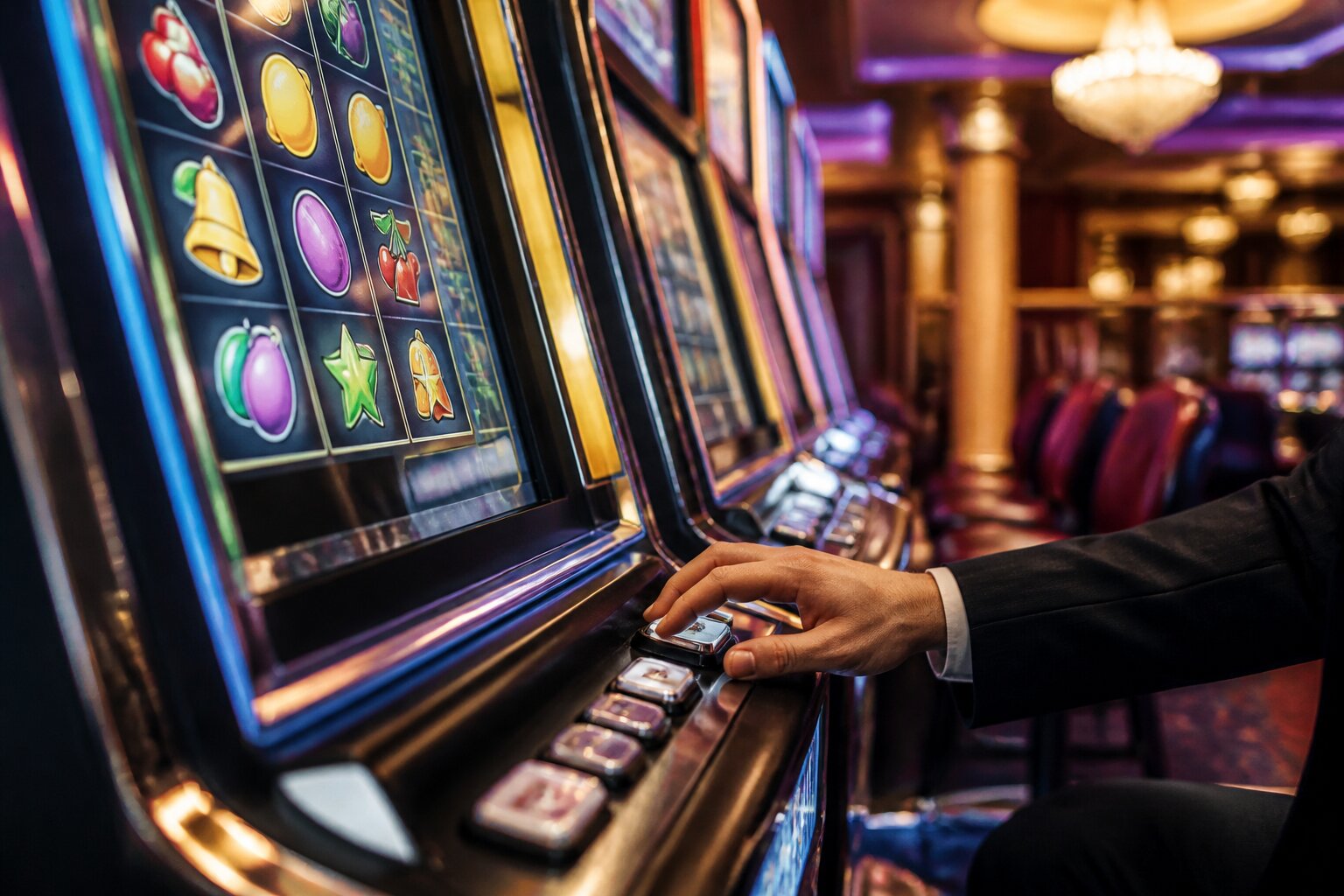
Ever had that moment where you hit ‘spin’ on a slot machine and wonder where the money actually goes? With flashing lights, themed reels and the chance of a sudden big payout, slots are the most-played games both online and in physical casinos. Behind the spectacle, though, a clear mathematical system determines how the money flows.
If you enjoy a few spins for entertainment or are curious about the mechanics, it helps to understand how outcomes are set, why some sessions feel generous and others stingy, and how the operator maintains a long-term advantage.
It’s less mysterious than it looks: rules, probabilities and industry standards ensure each game returns a defined share of stakes to players over time while leaving a margin for the casino.
How Do Slot Machines Actually Work?
Slot machines, whether mechanical antiques or digital titles on a website, follow the same core model: you spin reels, line up matching symbols along specific patterns (paylines), and win when the symbols meet the payout conditions. Modern games present that mechanism through polished graphics and sound rather than spinning metal.
Contemporary slots are run by software. The visible reels and paylines are visual representations; the real decisions happen in the background when the game maps a random outcome to the display. Paylines determine where symbols must land to create a reward—some games use a single straight line, others use multiple intersecting patterns. Special symbols, like wilds and scatters, provide ways to substitute or trigger bonus features such as free spins or mini-games.
Because the core mechanics are consistent across formats, it’s straightforward to move from understanding paylines to grasping the house advantage that follows. That leads directly into how casinos secure a predictable margin on every game.
The House Edge Explained
The house edge is the built-in advantage that guarantees the casino a steady return from slot play over the long run. Expressed as a percentage, it represents the share of every pound wagered that the operator expects to retain on average.
For example, a slot with a 5% house edge will, in theory, keep £5 of every £100 wagered and return £95 in prizes over a sufficiently large sample of spins. Other games might sit closer to 3% or as high as 10%, and most modern video slots generally fall somewhere between 94% and 97% in terms of Return to Player (RTP)—the portion returned to players over time.
These percentages are long-term averages calculated across many spins. Individual sessions can see wide swings: some players win more than the RTP would suggest, while others lose more. The edge only becomes apparent when results are aggregated over thousands or millions of spins.
Random Number Generators & Fairness
A random number generator (RNG) is the component that determines each spin’s outcome. It continuously cycles through number combinations and selects one for a spin the moment the player acts. Because the process is automated and independent for every play, outcomes cannot be predicted and are not influenced by previous results.
Regulated games undergo independent testing to confirm the RNG behaves correctly and that the stated payout figures are accurate. Testing involves analysing large samples of spins to ensure the distribution of outcomes matches the game’s design and theoretical probabilities. Operators and regulators also audit games periodically so settings remain consistent and any software updates do not alter intended performance.
Those independent checks include statistical analysis, code reviews and runtime verification. Certification bodies issue reports and, where appropriate, a certification seal that indicates the game has met the required standards. With that technical foundation in place, the next section explains how those payout figures are communicated to players through RTP and payback percentages.
Are Slot Machines Truly Random?
Regulated slot games are designed so each spin is independent and unpredictable. The RNG gives no memory of what happened before, and there is no reliable way to forecast what comes next.
Randomness in practice still means short-term variance is possible. Over many plays the outcomes tend to conform to the game’s probability model, but individual sessions can show large swings. Responsible operators make this clear to players and provide information about typical return behaviour.
How Do Casinos Ensure Games Are Not Rigged?
Before a game is made available, independent testing bodies examine the RNG and payout structure to verify fairness. After release, regular audits check that nothing has been altered and that the live product matches the certified version. These checks protect players and ensure the advertised return rates are genuine.
Operators also keep logs and version controls for game software, and regulators require transparent reporting and access for inspections. Where problems are found, licences can be suspended and corrective actions mandated to restore fair play.
Payback Percentage vs. Return to Player (RTP)
Payback percentage and Return to Player (RTP) describe the same idea: the proportion of all stakes a slot is expected to pay back over a long timeframe. RTP is the more commonly used term and is normally shown as a percentage on each game.
So a 96% RTP means that, across many spins, the game will return approximately £96 for every £100 wagered, keeping about £4 as the operator’s margin. RTP figures are statistical averages, not guarantees for a single session, and they’re useful for comparing how games distribute returns across time.
Understanding RTP helps explain why some slots feel more generous than others, which brings us to volatility—the factor that controls how often and how big the wins tend to be.
Why Do Some Slots Pay Out More Often Than Others?
How often a slot pays out, and the typical size of those payouts, depends on the game’s volatility (or variance) and its feature set. Volatility is a design choice: low-volatility games deliver more frequent, smaller wins, while high-volatility games produce fewer wins but allow for larger payouts when they occur.
Low-volatility titles suit players who prefer regular action and a steadier bankroll movement. High-volatility games cater to those who accept longer dry spells in pursuit of the chance of a sizeable win. Progressive jackpots take this further by diverting a portion of each stake into a growing prize fund, which reduces the frequency of wins but raises the potential top prize.
These behaviours are programmed into the game’s prize table and the RNG logic, so what feels like generosity in one session is simply how that particular game is intended to play.
Misconceptions About Slot Profits
There are several persistent misconceptions worth clearing up. One is the idea that a machine becomes ‘due’ to pay out after a run of losses. Because each spin is independent, there’s no built-in memory to make a future spin more likely to win. Another is the belief that timing or certain strategies can change outcomes—regulated games prevent any such influence.
Some players worry online slots are less fair than physical machines or that operators can adjust settings on the fly. In practice, any meaningful change to payout figures requires testing and approval; audits and regulator oversight are in place to prevent covert adjustments.
With those misunderstandings addressed, it’s useful to look at how design choices in sound, graphics and features influence player behaviour without affecting the underlying maths.
Slot Machine Design: What Influences Player Behaviour?
Design elements shape the playing experience and encourage continued engagement. Visual themes and character designs create context that draws players in, while sound effects—cheers, chimes and rhythmic beats—heighten the sense of excitement when spins resolve. Bonus features such as free spins, respins or mini-games add layers of anticipation and often extend play without additional stake for a few rounds.
Manufacturers sometimes use near-miss visuals or dynamic animations to create suspense by showing outcomes that almost line up, which can prompt another spin. These techniques affect how a session feels, but they do not alter the statistical probabilities determined by the RNG and RTP.
If play becomes less enjoyable, players are encouraged to stop and reassess their approach; sensible limits and clear information about RTP help people make informed choices about how they engage.
The way slots combine mathematics and design explains why they remain so popular while ensuring the operator’s margin is preserved across time. As you move between machines or games, those same principles—RTP, volatility and RNG behaviour—are what determine the likely pattern of wins and losses, so you can choose titles that match the kind of session you prefer.
Play Online Slots at Slots Baby
We would love for you to experience the entertainment we offer at Slots Baby, where everyone is welcome. Our site is designed to be friendly and easy to use, so you can enjoy playing at your own pace.
Getting started is straightforward: just set up your account, make a deposit and you are all set to play. We hope to welcome you soon for a fun and enjoyable experience.
**The information provided in this blog is intended for educational purposes and should not be construed as betting advice or a guarantee of success. Always gamble responsibly.