
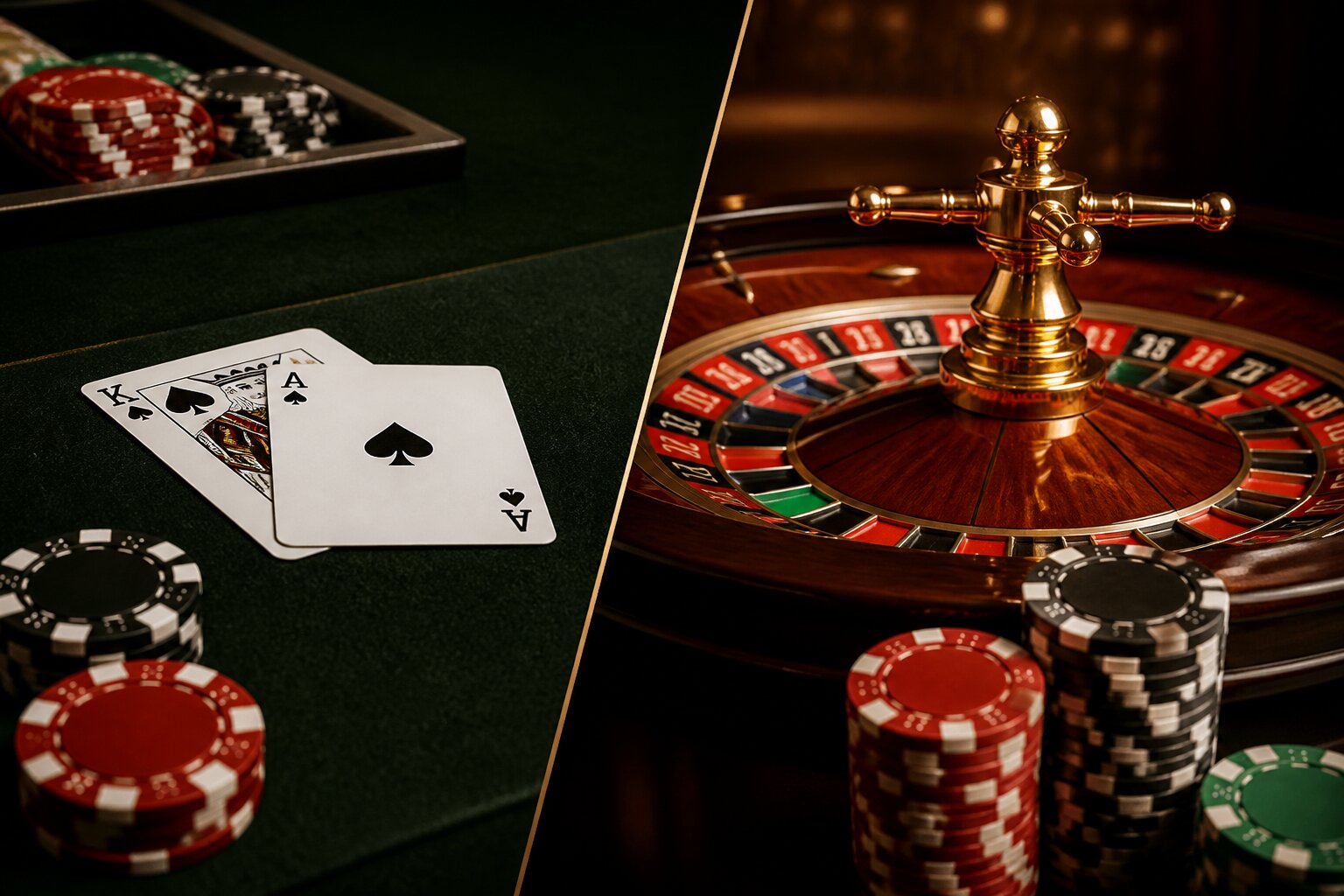
Choosing between blackjack and roulette at an online casino can feel tricky, especially if you’re new to one or both games. Both are popular for good reason, but they’re very different in how they work, the strategies they use, and how much you could potentially win.
Understanding the differences helps you pick the game that suits your temperament and goals, whether that is strategic decision-making or simple, social play. Read on to see how each game works, what the odds and payouts look like, and what to expect when you sit down to play.
What Are the Main Differences Between Blackjack and Roulette?
Blackjack and roulette may be close on the casino floor, yet they deliver very different experiences. Knowing how they contrast will make it easier to choose which one to try.
Game Style
Blackjack is a card game played against the dealer, with a clear numerical target: get as close to 21 as possible without going over. Each hand involves dealing, assessing your cards, and deciding whether to take another card or keep your total. The game rewards informed choices and an understanding of card values, along with basic awareness of the house rules at the table you join.
Roulette centres on predicting where a ball will come to rest on a spinning wheel marked with numbered pockets. Bets are placed before the spin and, once the wheel is in motion, the result is down to chance and cannot be influenced. Typical bet types include:
- single numbers
- groups of numbers
- colours such as red or black
- odd or even and other pattern-based options
This difference means blackjack mixes skill and chance to varying degrees, while roulette is primarily a game of chance with a wide range of bet types and payoffs.
Player Interaction and Decision-Making
Blackjack offers direct control over many outcomes through player choices such as hit, stand, double down and split. These decisions change the course of a hand and can affect your short-term results. Players who prefer a more involved style will often enjoy the need to make timely choices and to adapt to the cards they receive.
In roulette, decision-making is limited to choosing which bets to place before the spin. There is no influence on the outcome after bets are set, so the game is about choosing a risk-reward profile that fits you. Some players like the simplicity and variety of bets, while others prefer games where choices during play matter more.
Social Feel
Blackjack often feels more intimate; you are focused on the dealer and your own hand, even when at a shared table. The pace can be steady and conversational, especially at lower-stakes tables where dealers and players chat as hands are played.
Roulette tends to be more communal, with several players backing the same number or colour and reacting together as the ball falls. The spin-and-wait rhythm produces moments of collective excitement and is well suited to groups or casual spectators. Which atmosphere appeals most to you may guide your choice.
How Do the Rules of Blackjack Compare to Roulette?
The rules of each game are designed to be clear and fair, yet they lead to very different rhythms and strategies at the table.
Blackjack Rules
Each player receives two cards at the start of a round. Face cards count as ten, aces can count as one or eleven, and other cards keep their numerical value. Players decide whether to take additional cards or stop, and options such as doubling down or splitting pairs add strategic depth. If a hand exceeds 21, it busts and loses for that round.
Different table rules — for example, whether the dealer hits on a soft 17, or how many decks are used — change the precise odds and strategy, so it is useful to check those details before you play.
Roulette Rules
Roulette revolves around a wheel and a betting layout. Players place chips on numbers or groups of numbers, the dealer spins the wheel and releases the ball, and the pocket where the ball settles determines the winners. Bets on single numbers pay the most, while outside bets such as red/black or odd/even pay less but offer higher chances of success.
Roulette wheels vary: the European version includes a single zero, while another variant includes a double zero, and each version alters the house advantage.
If you are curious how rule differences affect your chances, the next sections look at betting options, odds and payouts in more detail.
Understanding the Betting Options in Both Games
Both games present a range of bets, from conservative to high-risk, and understanding them helps you choose a style of play that fits your bankroll and mood. Knowing the likely returns and the house edge for different wagers makes it easier to manage stake size and session length responsibly.
Blackjack Betting Options
A standard round begins with a single wager. During play you have a few common options that change how much you risk and how the hand is played:
- Split identical cards into two hands, which doubles the stake for those hands and lets you play each separately.
- Double down to increase your wager in exchange for receiving just one additional card.
- Take insurance when the dealer shows an ace; this is a separate side bet that pays out only if the dealer has a natural blackjack and has different odds and expected value compared with the main bet.
Table rules and allowed side bets vary between casinos and tables, so checking the specific offering matters for both strategy and expected value. Typical variations that affect the house edge include whether the dealer hits or stands on soft 17, how many decks are used, and whether doubling after a split is permitted. These rule differences can change the optimal play and long-term return, so review them before you sit down.
Roulette Betting Options
Roulette gives many ways to bet, with options that trade frequency of wins against payout size. You can place very small, frequent wagers or risk larger sums on long-shot outcomes.
Central bet types include:
- Straight up bets on a single number, which pay the most but are statistically the least likely to win.
- Bets covering adjacent numbers or small groups, such as splits and streets, which offer higher payouts than even-money bets but occur less often.
- Column and dozen bets that cover larger sections of the wheel and provide mid-range payouts.
- Outside bets that cover red/black or odd/even, which typically return even money and have the highest probability of success.
Each bet type balances chance and payout differently, allowing players to select an approach from cautious to speculative. House edge varies only slightly between bets in single-zero (European) wheel, but the presence of additional pockets, such as a double-zero (American) wheel, increases the casino advantage. Always check which wheel variant and table limits apply before placing your chips.
Comparing Odds: Which Game Offers Better Chances of Winning?
Odds differ markedly between blackjack and roulette, and they are shaped by both game rules and player choices.
Blackjack Odds
Blackjack’s edge depends on the specific rules in play and the decisions a player makes. Using basic strategy — a set of mathematically informed choices about when to hit, stand, double down or split — the house edge typically falls between about 0.5% and 2%. That lower edge reflects the fact that players have some control over outcomes through skillful decision making.
Several rule variations move the house edge up or down. Important factors include:
- the number of decks used,
- whether the dealer hits or stands on a soft 17,
- whether doubling after splitting is permitted,
- whether surrender is available, and
- payout for a natural blackjack (for example 3:2 versus 6:5).
Each of these changes can add or remove tenths of a percent from the house advantage. Short-term results can still vary widely because of luck, but over many hands strategy and favourable rules generally improve a player’s long-term chances compared with purely random games.
Roulette Odds
Roulette odds depend on the bet type and the wheel version. Bet size and choice determine the payout and the probability of winning, while the wheel layout determines the house advantage.
Typical examples on the common wheels include:
- an even-money bet on a single-zero (European) wheel, which has a probability close to 48.6% and a house edge of about 2.70%,
- a straight up number bet on that wheel, with roughly a 2.7% chance of landing,
- the double-zero (American) wheel, which increases the house edge to about 5.26% compared with the single-zero wheel.
These percentages are averages over many spins and are useful for setting realistic expectations. Roulette outcomes are entirely determined by chance on each spin, so short-term wins or losses can be large even though the long-term math favours the house.
Payouts Explained: How Much Can You Win in Blackjack vs Roulette?
Payout structures determine how wins are returned and influence which bets attract players. Understanding typical payouts helps you weigh risk against potential reward and choose bets that suit your play style.
Common Blackjack Payouts
Most winning blackjack hands pay even money, meaning your stake is returned plus an equal amount in winnings. A two-card blackjack traditionally pays at 3:2, offering a significantly larger return for that specific outcome compared with a regular win.
Some casinos use different blackjack payouts, for example paying 6:5 instead of 3:2, which reduces the return on a natural blackjack and increases the house edge. Side bets such as insurance, pair bets or other optional wagers have their own payout schedules. Because these side bets function differently from the main game, they usually carry a higher house edge and should be treated as separate risks.
Always check the specific table rules, as dealer behaviour and rule variations can affect expected returns.
Typical Roulette Payouts
Roulette payouts scale with probability: the less likely a bet is to win, the larger the payout. Common examples include:
- Single number (straight up) — typically pays 35:1.
- Split bet (two numbers) — typically pays 17:1.
- Street bet (three numbers) — typically pays 11:1.
- Corner bet (four numbers) — typically pays 8:1.
- Six-line bet (six numbers) — typically pays 5:1.
- Outside bets such as red/black, odd/even or high/low — typically pay 1:1.
The variety of bet types lets players trade frequency of success for size of payout depending on their preference. Note that the presence of the single zero (European roulette) or single and double zeros (American roulette) changes the house edge and therefore the effective value of each payout.
Before wagering, it is sensible to check the paytable and the specific rules for the table or game variant you plan to use. Set limits, know the odds, and only gamble with money you can afford to lose. If you are concerned about your gambling, seek help from a recognised support service.
House Edge: Is Blackjack or Roulette More Favourable?
House edge is the metric that tells you how much the casino keeps on average from each bet. It is useful for comparing games and for long-term expectations. Bear in mind these numbers are statistical averages calculated over many, many wagers and do not predict short-term outcomes.
Blackjack House Edge
When players use optimal basic strategy and play at favourable rule tables, blackjack’s house edge can be quite low, often between 0.5% and 2%. That low edge is what makes blackjack attractive to many players who learn the correct play and manage their bankroll.
Table variations and optional side bets will shift that number. Specific rule changes that affect the edge include:
- whether the dealer hits or stands on soft 17,
- limits or allowances on doubling down,
- whether surrender is permitted,
- the number of decks in use,
- payouts for blackjack and any side bets rules.
Side bets in particular usually carry a much larger house edge than the main game, so they tend to increase overall disadvantage. Even with good strategy, individual sessions can swing widely because of variance, so the long-term edge does not remove short-term ups and downs.
Roulette House Edge
The single-zero wheel has an advantage of about 2.7%, while a wheel with an extra zero pushes that figure higher, around 5.26%. That simple difference in wheel layout is the main reason roulette usually gives the house a larger long-term advantage compared with well-played blackjack.
Different bet types on the wheel do not change the underlying house edge; they only change how frequently wins occur and the size of those wins. As with blackjack, these percentages are long-term averages and do not guarantee any particular result in a short session.
These figures are averages calculated over long periods; they help you decide which game aligns with your tolerance for risk and expected returns. Remember to play responsibly: there are no certainties in gambling, and outcomes are random.
Myths About Blackjack and Roulette: What Should UK Players Know?
Clarifying common misconceptions keeps expectations realistic and reduces the chance of risky decisions. That helps you make calmer, more informed choices while playing and reduces the likelihood of chasing losses or escalating stakes.
Myth: “You Can Beat the House with a System”
Many betting systems promise predictable wins, but no approach removes the house edge. Systems may change how your results look in the short term, or how volatility feels, yet they do not alter the fundamental probabilities that give the casino an advantage.
A system can make losses or wins seem more regular, and it might suit some players’ psychology, but it cannot guarantee long-term profit. Relying on a system as if it overturns the maths can lead to greater losses and riskier play.
Myth: “Previous Outcomes Affect Future Results”
Both individual roulette spins and separate blackjack hands are independent events. Past results do not influence future outcomes, so basing decisions on perceived streaks is not a reliable tactic.
Even when patterns appear, they are the product of random variation rather than any causal link. Treat each round or spin on its own terms and avoid letting recent results drive large changes in your stakes.
Myth: “Big Wins are More Likely After a Losing Streak”
There is no mechanism that makes a big win more likely simply because losses preceded it. Each bet or spin has its own odds, independent of what happened before.
Chasing prior losses in the hope of a turnaround usually increases risk and can lead to spending more than intended. Keep bets within limits you set in advance and resist the urge to recover losses through larger stakes.
If you find these points affecting how you play, take a moment to review your approach before continuing. Consider simple safeguards such as setting time and money limits, taking regular breaks, and deciding a stop-loss in advance. If you have concerns about your gambling, seek support and consider self-exclusion tools offered by licensed operators.
Which Game Is Better for Beginners?
The best choice for a newcomer depends on whether you prefer a simple betting experience or one that rewards strategic thinking and quicker learning.
Things to Consider as a Beginner
Ease of play, learning curve and the style of engagement differ between the two games. Roulette is straightforward to learn: pick a bet and wait for the spin. Blackjack requires more decisions, but the rules are consistent and a basic strategy can be learned relatively quickly.
If you value direct decision-making and a lower house edge when you apply sound choices, blackjack may suit you. If you want simpler bets and a more social environment, roulette could be a better fit. Either way, check the table rules and limits so the game matches your budget.
Make sure you understand the rules and payouts for the table you choose, set sensible limits, and keep the experience enjoyable.
**The information provided in this blog is intended for educational purposes and should not be construed as betting advice or a guarantee of success. Always gamble responsibly.