
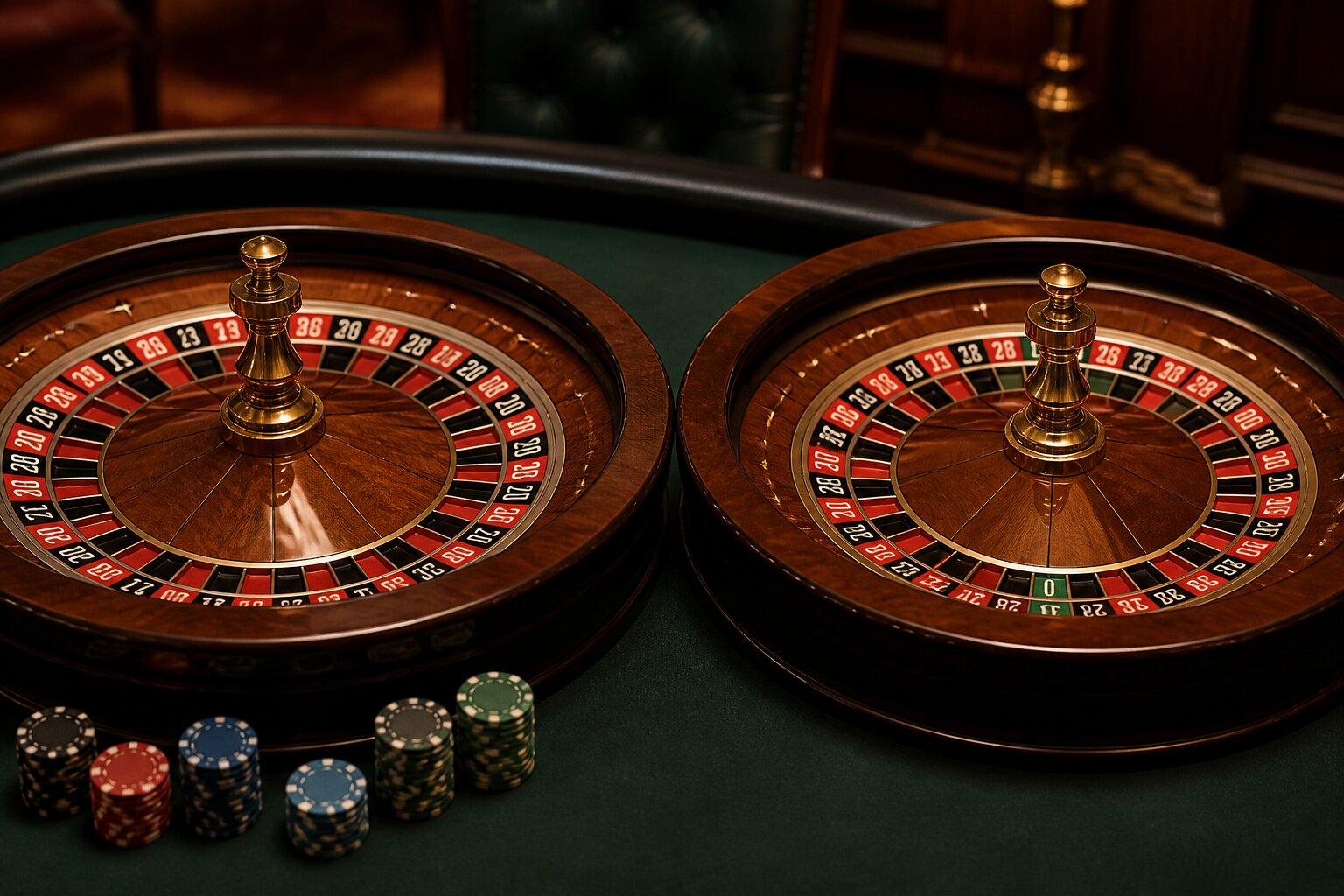
Ever wondered why experienced players in British casinos often head for the European roulette table? It goes beyond tradition—the differences between European and American roulette affect how the game plays and the relative advantage the house holds. Picture two gleaming wheels: both promise the thrill of a spin, yet each sets a different stage for how bets resolve.
This article explains the key distinctions in wheel layout, the rules that change how bets are handled, how those rules affect the house edge, and what that means for table layout and the player experience. Read on to see how small details can shape every spin.
Key Differences in Roulette Wheel Layouts
The most immediately visible difference is the number of pockets. The European wheel contains 37 pockets: numbers 1 to 36 plus a single zero (0). The American wheel has 38 pockets, adding a double zero (00) alongside the single zero. That extra green pocket increases the number of possible outcomes and changes the maths behind every bet.
The order of the numbers around each wheel also differs. The European layout is designed for a balanced spread of odd and even, red and black, while the American sequence follows a distinct arrangement that alters the flow of numbers encountered as the wheel turns. Visually, the single-zero wheel tends to look simpler, while the double-zero wheel has a more compact cluster of green pockets that players notice at a glance.
These structural differences matter because they feed directly into the rules and payouts that follow, so it helps to understand the wheel before looking at how bets are resolved. Next, we’ll explore the specific rules that vary between the two versions and the ways they affect outside bets.
How Do the Rules Differ Between American & European Roulette?
Rule differences centre on how even-money bets are treated when the ball lands in a green pocket and on which optional rules are available in each variant. European roulette commonly offers the La Partage and En Prison options, both of which reduce losses for even-money bets when the zero appears.
La Partage returns half of an even-money stake when the ball lands on zero. For example, a £10 bet on red would return £5 if zero appears. En Prison leaves an even-money bet "in prison" for the next spin; if that subsequent spin wins, the original stake is returned with no extra winnings, and if it loses the stake is lost. These rules lower the effective disadvantage players face on even-money wagers.
American roulette does not include La Partage or En Prison. If the ball lands on zero or double zero, standard outside bets are simply lost. The presence of both zero pockets therefore removes the protective options found in many European tables and increases the frequency with which green pockets negate outside bets.
Understanding these rule variations leads naturally into how they change the numerical house advantage, which is what determines long-term expected returns.
House Edge & Odds Explained
The house edge quantifies the casino’s long-term advantage on each bet type. Because European roulette has a single zero among 37 outcomes, its standard house edge is about 2.7%. A straight up bet on one number pays 35 to 1 while the true chance to win is 1 in 37, which is the source of that edge.
American roulette, with 38 outcomes due to the extra double zero, carries a higher house edge of roughly 5.26%. The straight up payout remains 35 to 1, but the chance to win falls to 1 in 38, widening the gap between the payout and the true probability.
For even-money bets the difference is clearer in practical terms: on the European wheel the probability of winning an even-money wager is 18 out of 37, while on the American wheel it is 18 out of 38. Using a £10 bet on red as an illustration, the expected return is about £9.73 on a European wheel and about £9.47 on an American wheel.
These percentages explain why some players prefer the single-zero game. With that settled, the next section looks at how those differences are reflected on the table and in the available bets.
Table Layout & Betting Options
Roulette tables mirror the wheel. Both versions present a numbered grid for inside bets and areas for outside bets, but the American table adds a separate box for the double zero. That extra space changes how certain bets are grouped and creates room for wagers that include the double zero.
Both games allow common inside bets such as straight up, split, street, corner, and six-line, and both offer outside bets on colour, odd/even, high/low, dozens, and columns. The American layout also supports the basket bet, which covers 0, 00, 1, 2, and 3; this bet does not exist on European tables because there is no double zero to include.
Inside Bets
- Straight Up: Bet on a single number (for example, 7).
- Split: Bet on two adjacent numbers (for example, 14 and 17).
- Street: Bet on three numbers in a horizontal line (for example, 22, 23, 24).
- Corner: Bet on four numbers in a square (for example, 1, 2, 4, 5).
- Six Line: Bet on six numbers across two rows (for example, 28–33).
- Basket (American only): Bet on 0, 00, 1, 2, and 3.
Outside Bets
- Red or Black: Bet on the ball landing on a red or black number.
- Odd or Even: Bet on the ball landing on odd or even numbers.
- 1–18 / 19–36: Bet on low or high numbers.
- Dozens: Bet on one of the three groups of 12 numbers (for example, 1–12).
- Columns: Bet on all numbers in one of the three vertical columns.
Table design influences how players place and combine bets and how dealers present the action, so the layout complements both the wheel and the rule set. With the mechanics and options laid out, the final consideration is which version suits different player preferences.
Player Experience: Which Version Should You Try?
Choice between the two versions usually comes down to priorities. Players who favour lower house advantage and options that reduce losses on even-money bets often prefer the single-zero format. Its table layout and optional rules can make sessions feel more measured, and many venues offer this version more frequently.
Others are drawn to the American game for its distinct look, the extra bets that use the double zero, and the different rhythm created by the wheel’s number order. That variation can feel more novel or lively to some players. Regardless of preference, both games provide the same basic range of inside and outside wagers and the social energy that draws people to roulette.
Whatever version appeals, set clear limits and view play as entertainment rather than a source of income. Keeping stakes within affordable bounds preserves the session as an enjoyable experience for everyone. This practical approach helps players focus on the game itself and on choosing the table that best fits the experience they want.
Play Online Casino Games at Slots Baby
We invite you to become part of our welcoming community of players at Slots Baby, where entertainment and great company go hand in hand. We are here to make your experience friendly and enjoyable every step of the way.
Getting started is straightforward: just create your account, make a deposit and you’ll be able to explore all the fun we have to offer. We look forward to seeing you with us soon.
**The information provided in this blog is intended for educational purposes and should not be construed as betting advice or a guarantee of success. Always gamble responsibly.