
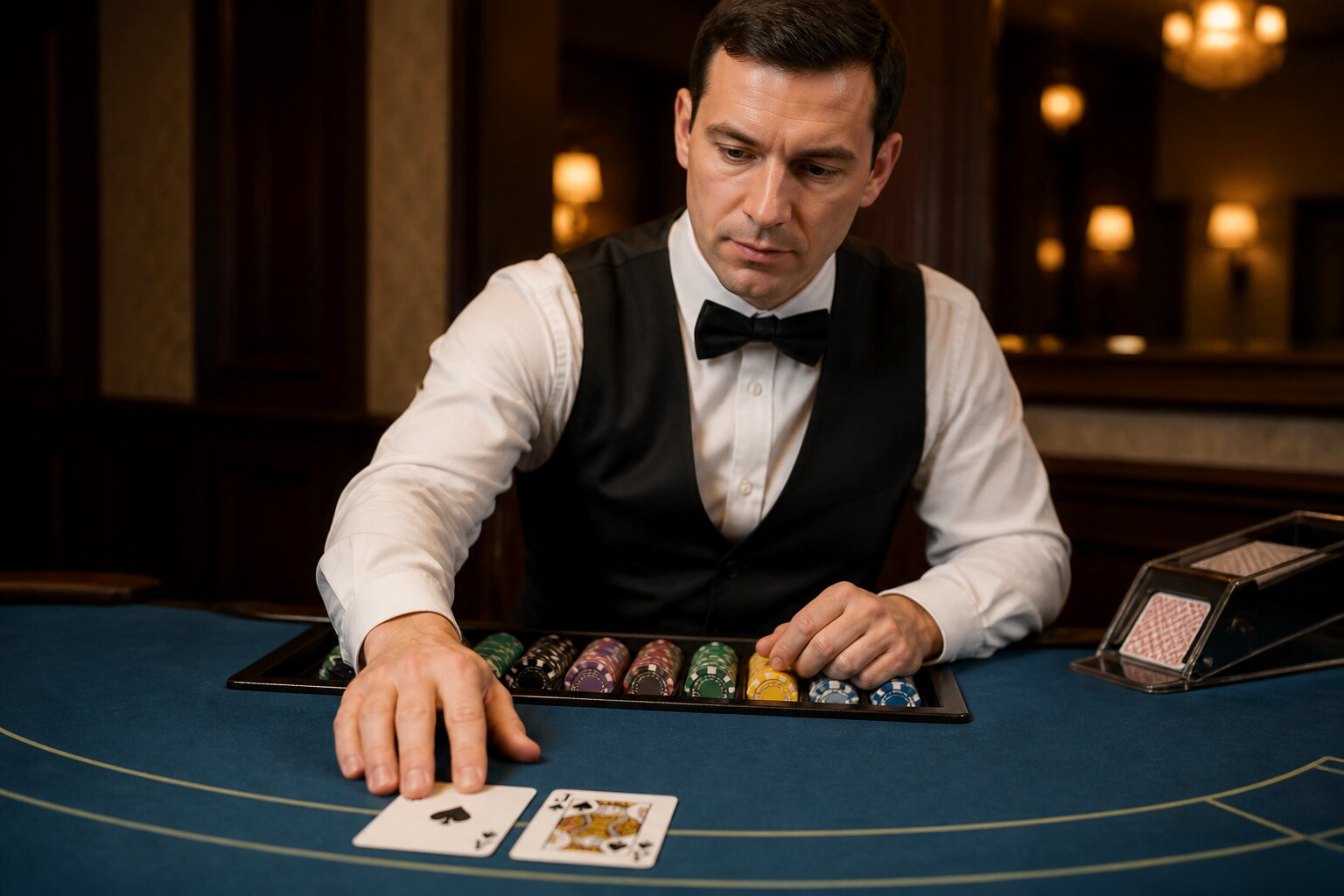
Ever watched a game of blackjack in a casino and wondered why the dealer has a quick peek at their cards before you get to play? It can look a bit mysterious—especially if you’re new to the game.
You might have noticed how swiftly they check, giving nothing away. There’s a practical reason behind that move, and it’s not secretive once you know what to look for.
If you’ve ever questioned what the dealer’s doing, or why they sometimes turn over an Ace or a face card so soon, you’re in the right place. Keep reading to find out what’s really going on behind that quick glance.
What Does It Mean When a Dealer Checks for Blackjack?
When a dealer checks for blackjack, they’re simply confirming whether their initial two-card hand is a natural blackjack — an Ace paired with a 10-value card such as a 10, Jack, Queen, or King.
This check takes place after the cards are dealt and before players make any further decisions. If the dealer’s visible card is an Ace or a 10-value card, the dealer examines the face-down card to see if it completes a blackjack. If it does, the round is resolved immediately for everyone at the table.
The purpose is practical: it prevents unnecessary play when the outcome is already determined by the dealer’s hand. It also means all players receive the same information at the same time, which helps the round move on without confusion.
How Do Dealers Instantly Identify Blackjack?
Dealers follow a simple, consistent routine to check for blackjack, set by the casino’s procedures. When the visible card is an Ace, the dealer uses a controlled, discreet method — often a slight lift of the card or a small table device — to glimpse the face-down card without revealing it to players. The same routine applies when the exposed card is a 10-value card and an Ace might be hidden.
The technique is designed to be quick and neutral so no extra information leaks to players. Training emphasises consistent handling: the same motion, the same angle, the same avoidance of drawing attention. Supervisors and table equipment support this, reducing the chance of error and keeping the process smooth.
Knowing how the check is done helps explain why it feels so instantaneous: it’s a practiced part of the game’s protocol, not a hurried guess.
When Do Dealers Perform the Blackjack Check?
The check happens immediately after every player and the dealer have been dealt two cards, but crucially before players take further actions such as hitting, standing, doubling, or splitting.
If the dealer’s up-card is an Ace or a 10-value card, that triggers the peek at the face-down card. Because this occurs up-front, the round can end quickly if the dealer has a natural blackjack, sparing players from placing extra bets or making decisions that would be pointless.
Timing matters here: the check protects both the table’s pace and the fairness of play, ensuring everyone proceeds from the same starting point.
To see how this affects the flow at the table, read on — the next section explains why this routine benefits both players and the house.
Why Is the Process Important for Players and the Casino?
The checking routine supports clarity and consistent application of the rules. For players, it means immediate clarity about whether the dealer has a natural blackjack, so there’s no wasted play or confusion about the round’s status.
For the casino, the check is part of maintaining an orderly, rule-bound game. It helps prevent disputes by resolving the simplest possible outcome early on. Supervisory practices and table procedures make sure the check is performed uniformly across shifts and dealers, which protects the integrity of the game.
Because the practice is standard across regulated venues, it gives both sides confidence that the round is being handled transparently and according to established rules.
If you’re wondering about common concerns, the next section clears up a few persistent myths.
Common Myths About Dealer Blackjack Checks
A number of misconceptions surround the dealer’s peek, so it helps to separate fact from fiction.
One myth claims dealers can signal certain players that they have blackjack. In reality, checks are performed in a standard way under observation, and no extra information is given to specific players. Another idea is that you can glean the dealer’s hand from subtle movements; dealers are trained to use the same neutral motion every time precisely to avoid that. Some players think the peek favours the house beyond the normal rules, but the routine simply enforces those rules efficiently.
Understanding these points removes much of the mystery and lets you focus on the strategic parts of the game rather than on imagined signals or hidden advantages.
Next, let’s consider what happens if human error does occur — it’s rare, but worth knowing how it’s handled.
Can Dealers Make Mistakes When Checking for Blackjack?
Even with training and supervision, human error can occasionally occur. A dealer might misread a card, make a handling slip, or fail to perform the check correctly. Most venues have safeguards to catch and correct such mistakes quickly: supervisors monitor play, and procedures are in place for resolving disputes.
When an error is identified, the usual response is to correct the outcome based on the established rules for the game, with supervisors stepping in to ensure fairness. Regular training and audits are used to keep mistakes to a minimum and to maintain trust at the tables.
This approach helps keep game integrity high while allowing for prompt remedies when something does go wrong.
What Happens If the Dealer Has Blackjack?
When a dealer confirms a natural blackjack, the table follows clear rules for settling bets and concluding the round.
Immediate outcomes are straightforward: the dealer reveals their cards, and any player who also holds a natural blackjack typically pushes, meaning their stake is returned. Players without blackjack lose their bets for that round, which concludes for them without further play. Once the hands are settled, the table prepares for the next deal and the cycle begins again.
If you’re ready to join a game, check the table limits and rules; our dealers are here to keep play moving smoothly and fairly. Enjoy the experience, keep within your limits, and play responsibly.
**The information provided in this blog is intended for educational purposes and should not be construed as betting advice or a guarantee of success. Always gamble responsibly.