
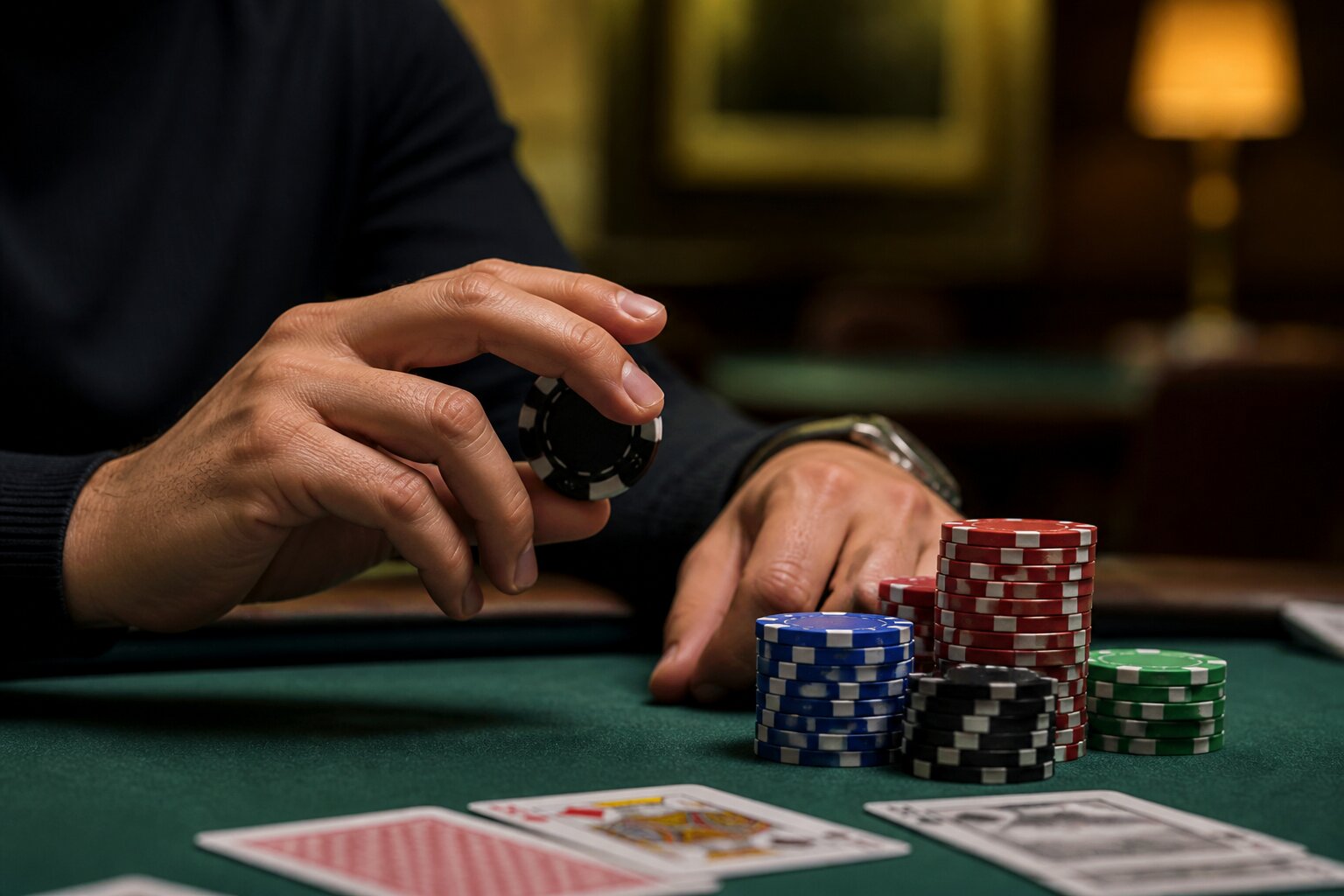
Ever noticed how poker players are always fiddling with their chips? Whether they’re stacking them neatly or rolling them between their fingers, those small movements are one of the most recognisable parts of the game.
There’s more to it than habit or showmanship. Chip handling mixes practical needs, personal comfort and a little table psychology, and once you see what to look for it gives a clearer picture of how a game is played.
Curious about what those tell-tale movements mean and how they affect the mood at the table? Read on — the next sections explain the etiquette, common techniques and what to avoid so you keep your game flowing smoothly.
Chip Handling Etiquette in Poker Games
Good chip etiquette keeps the game fair and efficient, and it also keeps the atmosphere pleasant for everyone. The basic idea is to make your stack easy to read and difficult to mistake.
Keep your chips stacked neatly in front of you so the amount you have is visible to the dealer and the other players. When placing a bet, put your chips forward in a clear, single stack so there is no confusion about how much you have committed. Avoid throwing chips directly into the pot; that can make counting difficult and slow the hand down.
Limit fidgeting that creates noise or distraction. Small movements to settle your hands are normal, but continuous handling that draws attention away from the game is inconsiderate. Also, never touch another player’s chips — only handle your own and wait for your turn to act.
These simple habits help the dealer move the game along and reduce disputes over amounts, keeping the table running smoothly and fairly.
There’s a subtle link between etiquette and table tone: respectful play encourages others to do the same, which leads naturally into the next topic about flair and distractions.
Is Chip Tricks a Distraction or Just Style?
Some players perform tricks such as spinning chips or juggling small stacks. For some it’s a relaxed way to occupy their hands while thinking. For others it reads as showmanship, and for a few it can be irritating.
The important balance is whether those actions interfere with play. Noisy or attention-grabbing tricks can disturb concentration, slow the game and annoy nearby players. In a live setting it’s considerate to keep any flair low-key and to stop if someone seems bothered.
When tricks are done quietly and sparingly they add personality without disruption. The best approach is to be aware of the room and adjust — what feels stylish at one table can be distracting at another.
Common Chip Handling Techniques and Their Purpose
Across tables you’ll see a small set of repeated techniques, each serving a straightforward purpose.
Shuffling chips between the fingers is common. Many players find this motion calming and it keeps their hands busy during the quieter moments of a hand.
Stacking chips into organised piles makes it easier to track totals and act quickly when a decision is required. Neat stacks reduce counting errors and speed up the dealer’s work.
Riffling — splitting a stack and merging it back together — is another repeated motion. Like shuffling, it tends to be a personal habit that helps some players focus rather than a strategic move.
All of these techniques centre on comfort and organisation. They don’t influence the cards or the result; their practical value lies in improving clarity at the table and helping players manage tension quietly.
Because these motions can indicate how settled someone is, they sometimes carry unintended signals — which leads us to how chip handling can affect psychology at the table.
Does Chip Handling Affect Gameplay or Psychology?
Handling chips won’t change the cards, but it can have subtle psychological effects within a hand. For some, keeping their hands occupied helps concentration; for others, increased fidgeting can hint at discomfort or indecision.
Opponents may notice more movement and form impressions, but such cues are unreliable by themselves. A player who appears restless might simply be bored or tired rather than about to make a particular move. Reading these behaviours in context — combining them with betting patterns and table actions — gives a much clearer picture.
The practical takeaway is that chip handling can influence perception, even if it doesn’t affect outcomes. Players who want to manage how they’re read should aim for consistent, calm handling so their behaviour doesn’t create misleading signals.
If you’re trying to present a steady image, consider simpler, quieter techniques; they keep attention on the play rather than on mannerisms.
Myths About Chip Handling in Poker
Several persistent myths about chip handling deserve correcting. One is the idea that skilled chip tricks reveal a superior player; a polished technique simply means someone practised a physical skill, not that they play better.
Another myth is that particular ways of stacking or shuffling can sway the cards or influence fortunes. That isn’t the case — the mechanics of the game are independent of how chips are handled.
Believing these myths can distract from what actually matters at the table: understanding the rules, paying attention to opponents’ actions, and making thoughtful decisions. Table mannerisms can be entertaining, but they aren’t a substitute for solid play.
How to Improve Your Own Chip Handling Skills
If you want to be neater or more confident with chips, a little practice helps. Working on basics will make your stack easier to read and your actions less likely to be misinterpreted.
Practise at home with an old set of chips or coins to get comfortable with stacking and simple shuffling motions. Focus on neatness so your stacks are easy to count, and on slow, deliberate movements to avoid noise and distraction.
Be mindful of time spent practising and keep it balanced with other activities. When you play in public, adapt to the table: quieter rooms call for subtler handling, while a casual home game may be more forgiving.
Above all, remember that chip skills are about personal organisation and presence at the table. They support better play and smoother games, but they are not a replacement for strategic thinking or sound decision-making.
Final thought: good chip handling is a small but useful part of poker — it helps you stay organised, avoids confusion, and keeps the focus on the cards and the play.
**The information provided in this blog is intended for educational purposes and should not be construed as betting advice or a guarantee of success. Always gamble responsibly.