
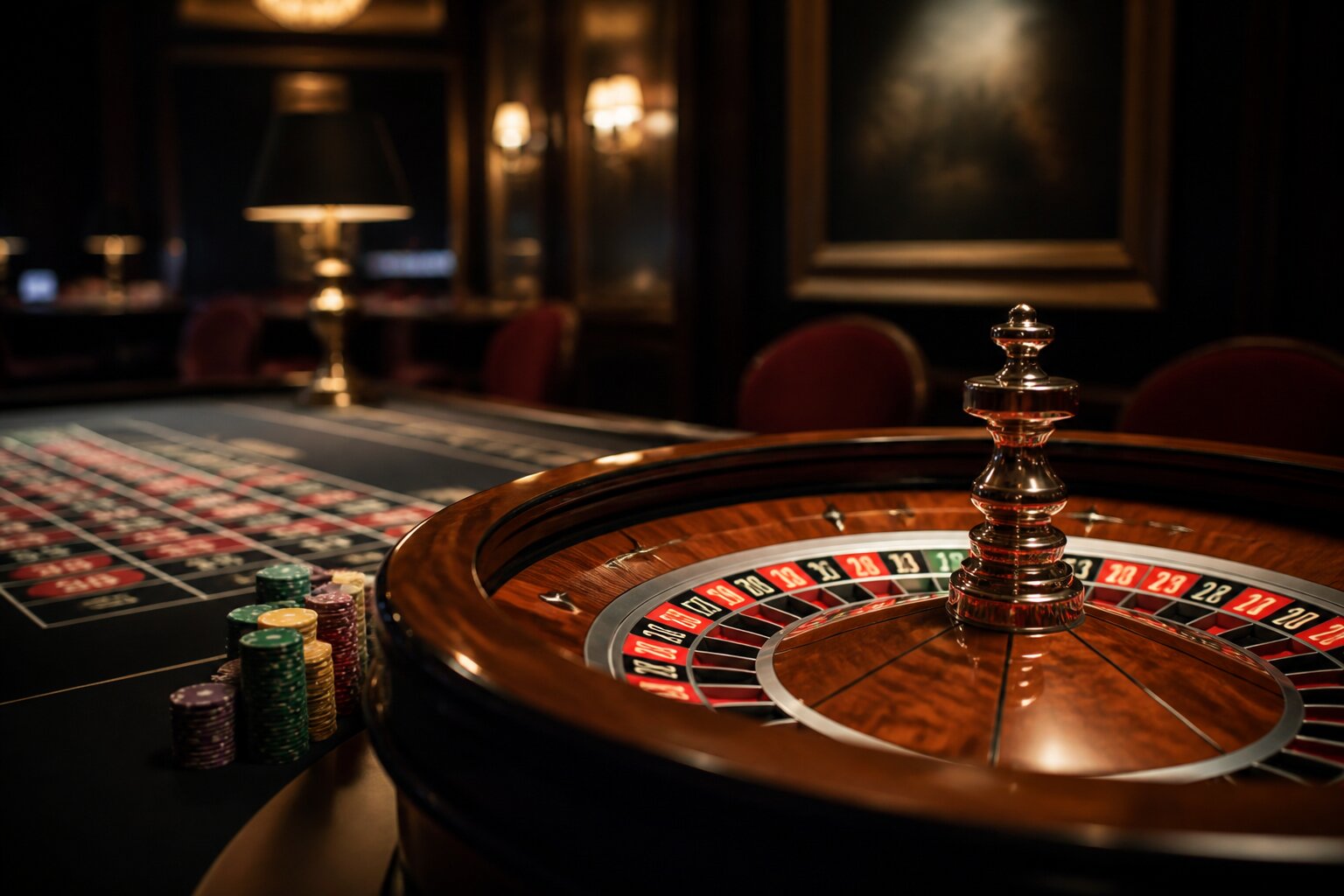
Ever watched a roulette wheel spin and wondered if there’s a secret formula to predict where the ball will land? You’re not alone. The game’s mix of simple rules and complex outcomes invites all kinds of theories and systems.
From probability to betting systems, many ideas promise an edge. This guide separates what maths can actually tell us from what’s wishful thinking, so you can approach the table with a clear view of the facts.
Read on to see what the numbers mean, why certain strategies fail, and what matters most when you decide to place a bet.
How Does Roulette Work? The Basics Explained
Roulette centres on a wheel with numbered pockets and a betting layout where players place chips. In European-style tables there are 37 pockets (numbers 1–36 plus a single zero). You choose bets on single numbers, groups of numbers, colours, even or odd, or high (19–36) and low (1–18).
Once bets are placed, the dealer spins the wheel one way and rolls the ball the other. When the ball settles in a pocket, winning bets are paid according to the odds for that bet type. Different bets offer different chances and different payouts; a straight-up number bet pays more but is less likely to land than a red/black or odd/even bet.
Understanding these basic mechanics is the first step to seeing how probability applies to each option on the table.
What Is the Role of Probability in Roulette?
Probability simply measures how likely an outcome is. In European roulette a single-number bet has a probability of 1/37, or roughly 2.7%. A bet on red covers 18 of the 37 pockets, so its chance is 18/37, about 48.6%.
These probabilities determine the payouts the casino offers. In practice this means:
- lower-probability outcomes pay more;
- higher-probability outcomes pay less.
The green zero or zeros sit outside the red/black and odd/even pairings, which slightly reduces the expected return on those so-called even-money bets compared with a true 50/50 split. That difference is the house edge, and it is what gives the casino a long-term advantage.
Knowing these percentages helps you compare bets and understand long-term expectations, variance and risk. It does not change the outcome of any individual spin, which remains random and independent of previous results.
Can Mathematical Models Predict Roulette Outcomes?
Mathematical models illuminate the structure of the game. They calculate:
- probabilities for different bets,
- expected values for players and the operator,
- how the house edge translates into an operator's long-term return,
- and they can simulate many spins to show how results tend to settle around statistical averages.
These tools are excellent for understanding the mechanics, typical returns and the variability you might expect over time. Simulations can also illustrate how short-term luck can differ markedly from long-term expectations.
What these models cannot do is forecast a specific future spin. Each spin is independent, with no causal link to previous results. Attempts to predict single-spin outcomes using past spins misunderstand that independence and usually reflect the gambler's fallacy rather than sound analysis.
Models are valuable for understanding risks and returns, helping with bankroll planning and appreciating volatility, not for producing a reliable prediction of the next pocket. Remember to gamble responsibly: mathematical insight can inform safer play but cannot remove the house edge or guarantee wins.
Why Are Roulette Wheels Designed the Way They Are?
Roulette wheels and tables are engineered to make outcomes as impartial as possible. The distribution of numbers, the alternation of colours and the physical balance of the wheel aim to minimise biases. Physical wheels are regularly inspected and, in regulated environments, tested by independent labs to confirm that spins are effectively random.
If a wheel were consistently biased toward certain pockets, that would show up in testing and prompt corrective action. The design choices reduce predictable patterns and help ensure every spin is governed by the same statistical rules.
This design intent matters because it underpins the mathematical independence described earlier: when a wheel is fair, historical results don’t improve your chances of future wins.
Is Beating Roulette Just a Numbers Game?
Because roulette displays clear numbers and payouts, it can feel as if a clever calculation should produce an advantage. In practice, however, the fixed probabilities and the small house edge mean no system can reliably convert those numbers into long-term profit.
Systems that adjust stake sizes based on previous results—such as increasing bets after losses—change the short-term variance you experience but do not alter the underlying expected value. They can raise the risk of large losses and run into table limits, both of which prevent the theoretical recovery they promise.
There is one situation where mathematics has helped real people: identifying mechanical bias in a physical wheel. Careful statistical analysis of many spins can reveal a defect or imbalance that produces an unusual frequency for certain pockets. That is exceptional and dependent on faulty equipment, not on a repeatable algorithm that works on fair wheels.
Common Myths About Algorithms and Roulette
Many myths circulate about “algorithms” that can predict outcomes. In this context, an algorithm is simply a method for organising calculations or bets; it cannot change physical or probabilistic laws. Likewise, doubling systems, progressive wagers and pattern-tracking tools may help manage play style, but they do not change long-term expectation.
Another misconception is that past runs—strings of reds, blacks, or particular numbers—signal anything about what comes next. Statistical runs occur naturally in random sequences; their presence doesn’t alter the probability for the next spin. Claiming otherwise confuses coincidence with causation.
If you encounter claims of guaranteed systems, the sensible response is to ask for rigorous evidence based on a large sample and independent verification. Extraordinary claims require extraordinary proof.
House Edge Explained: Why the Casino Always Wins
The house edge is the difference between true even odds and the payouts offered. In European roulette the single zero produces an average expected loss of roughly 2.7% on all bets. That figure comes from comparing the fair probabilities with the actual returns paid to winners.
To make this concrete: a long series of small wagers will, on average, return about 97.3% of the amounts staked, with the remaining 2.7% representing the casino’s expected margin. Short sessions can deviate widely from this average; large samples tend to converge toward it.
Crucially, no betting pattern or staking plan alters this built-in expectation. The edge is a mathematical consequence of the wheel’s structure and the payout table, so it persists regardless of how bets are sequenced.
What Do Experts Say About Beating Roulette with Maths?
Mathematicians and gaming experts consistently treat roulette as a well-understood probabilistic system. Their analyses focus on expected value, variance and risk management rather than on discovering predictive formulas. Where academic or technical work has made a difference, it has been in identifying equipment imperfections or modelling player behaviour—not in producing a reliable method for forecasting single spins.
Regulators and independent testing bodies emphasise transparency and fairness. They look for accurate information about odds, clear terms and proof that equipment and software are unbiased. When players are informed about probabilities and payouts, they can make decisions aligned with their preferences and budgets.
Experts therefore advise treating roulette as entertainment with known odds, not as an investment strategy.
Conclusion: The Truth About Roulette Algorithms and Probability
There is no algorithm or strategy that changes the fundamental probabilities of roulette or guarantees consistent wins. Mathematics explains why the house edge exists, how different bets compare, and how variance affects short-term play, but it does not offer a reliable way to predict individual outcomes.
If you choose to play, do so with a clear view of the odds and an awareness of the house edge. Keep stakes within a budget you’re comfortable with and seek information about how bets pay and what to expect. That approach protects your interests while letting you enjoy the game responsibly and without unrealistic expectations.
**The information provided in this blog is intended for educational purposes and should not be construed as betting advice or a guarantee of success. Always gamble responsibly.