
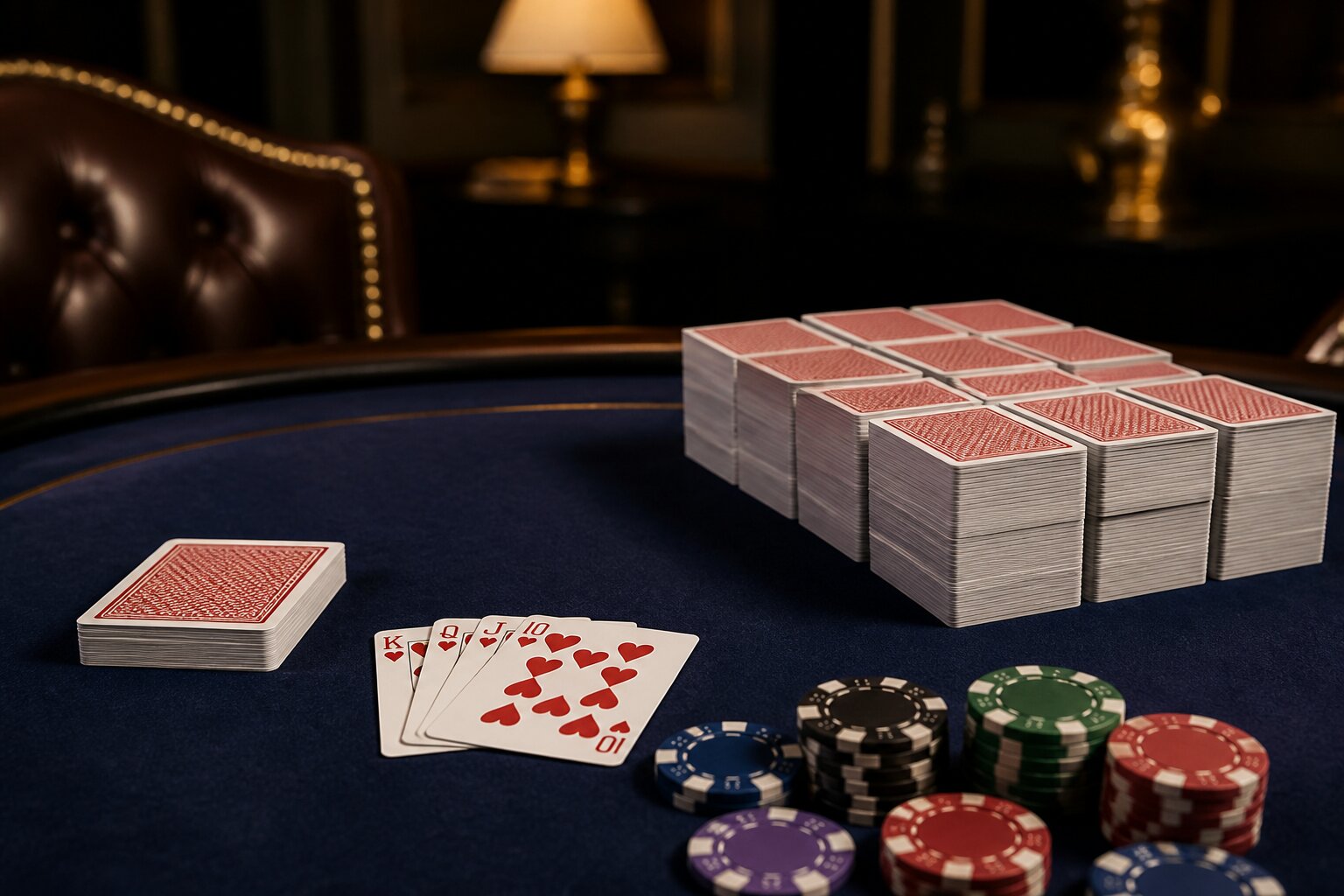
Poker is one of the most widely played card games, but there’s often confusion about how many decks are used at the table. Whether you’ve watched a televised tournament, played in a casino, or sat in on a home game, the deck situation can seem muddled.
The core answer is straightforward for standard play, yet there are useful exceptions and practical details worth knowing. Read on and you’ll be ready to join most games with confidence.
How Many Decks Are Commonly Used in Poker?
For the vast majority of poker games the table uses a single standard 52-card deck. That is the familiar setup for mainstream formats such as Texas Hold’em, Omaha and Seven Card Stud. Using one deck at a time keeps the game consistent and makes it easier to understand how hands form and compare.
In both live and licensed online settings the deck may be replaced between hands to avoid wear or marking. That does not mean multiple decks are combined into play; it means a new deck is substituted when needed so each hand starts with a full, standard deck.
Home games sometimes vary, adding jokers or using two decks for novelty, but such changes alter how hands work and are not the norm in formal play. If you join a new game, a quick check of the house rules will tell you what to expect.
Why Do Some Poker Games Use More Than One Deck?
When more than one deck appears around poker play, it is usually for practical reasons rather than to change the fundamental game. Large, busy card rooms aim to keep action flowing; while one deck is being shuffled or checked, another may be ready to deal. Even then, only one deck is used in any given hand.
In casual settings players sometimes introduce extra decks or jokers as a deliberate variant, to create different hand possibilities or to suit a particular social format. Those variations are fine for informal play, but they change the standard probabilities and should be agreed in advance.
The key point is that extra decks are a logistical or social choice, not a feature of standard competitive poker.
Which Poker Variants Have Unique Deck Requirements?
Most established poker variants use the same 52-card deck, but a few recognised exceptions exist. Certain novelty games or mixed formats may add one or two jokers as wild cards, and some home rules create bespoke variants where the deck composition is altered on purpose.
Formal tournaments and regulated cash games rarely, if ever, change the deck. When a game does specify jokers or an altered deck, the rules make this explicit so every player knows how hands will rank and what cards are in play.
If you encounter an unfamiliar variant, a quick read of the rules will clarify whether jokers or extra cards are used and how that affects the hand rankings.
Are Casino Poker Games Different From Home Games?
Yes — the settings are different in how strictly rules about the deck are applied. Casinos and reputable online operators follow established standards: one 52-card deck per hand, with procedures for shuffling and deck replacement to preserve integrity and clarity.
Home games lack that formal oversight, so players often experiment. That can be perfectly enjoyable among friends, but it also means the game may run to non-standard rules that affect hand possibilities.
If you prefer consistent, regulated play, choose environments where the format is published and enforced. That way you won’t be surprised by altered deck rules or unexpected variations at the table.
What Are The Benefits And Drawbacks of Using Multiple Decks?
Keeping to a single deck offers several clear benefits. It preserves the standard hand distributions players expect, makes it easier to read the pot and opponents, and reduces the chance of confusion. For dealers and organisers it simplifies monitoring and rule enforcement.
Using multiple decks can speed up dealing in high-volume rooms or create novelty in a social game. The downside is that it complicates tracking which cards remain in play and can make strategic decisions less intuitive. Because the card mix changes, experienced players may find it harder to assess probabilities or read opponents’ likely holdings.
Ultimately, the choice between one deck or more depends on the setting and the purpose of the game: consistency and clarity in regulated play, flexibility and experimentation among friends.
Does the Number of Decks Affect Poker Game Fairness?
In regulated venues, procedures and oversight ensure that deck handling does not undermine fairness. Operators must provide transparent rules and consistent dealing practices so every player faces the same conditions. These controls mean the number of decks used in practice does not create an unfair advantage.
Regulation also requires measures such as routine inspections, clearly written procedures for shuffling and cutting, and trained staff who follow standard dealing protocols. Together, these reduce the chance of accidental or deliberate irregularities affecting outcomes.
In contrast, informal games can vary widely. When a game does not follow a standard deck setup, it should be clearly explained before play so everyone understands the consequences for hand composition and strategy.
At a minimum, players should be told:
- how many decks are in use and whether jokers are included
- how and when the deck will be reshuffled or cut
- any house rules that change hand rankings or card removal
Knowing the deck arrangement in advance is the best safeguard for fair participation. Clear communication helps players make informed strategic choices and prevents disputes that can arise from unexpected variations in the deck.
Myths About Deck Numbers in Poker Explained
There are several common misunderstandings about decks in poker. Clarifying them helps you focus on what actually matters at the table.
Myth 1: More Decks Mean Better Odds
Changing the number of decks in a non-standard way alters the card supply, so it changes the structure of the game rather than improving any player’s chances. In standard casino and tournament play, the single-deck format is used consistently so hand distributions remain stable.
Myth 2: Deck Changes Are Meant to Confuse Players
Deck swaps are a routine part of cardroom maintenance. Replacing worn cards or rotating in a fresh deck preserves the integrity of play, and any such change is a practical measure rather than an attempt to confuse participants.
Myth 3: Jokers or Wild Cards Are Standard
Jokers and wild cards appear only in specific variants. Most formal poker formats use the standard 52-card deck without wilds, and any exception is normally declared before the game starts so everyone understands how hands will be evaluated.
If you want to be sure about deck makeup at any game, check the rules or ask. That keeps expectations clear and the experience straightforward.
**The information provided in this blog is intended for educational purposes and should not be construed as betting advice or a guarantee of success. Always gamble responsibly.