
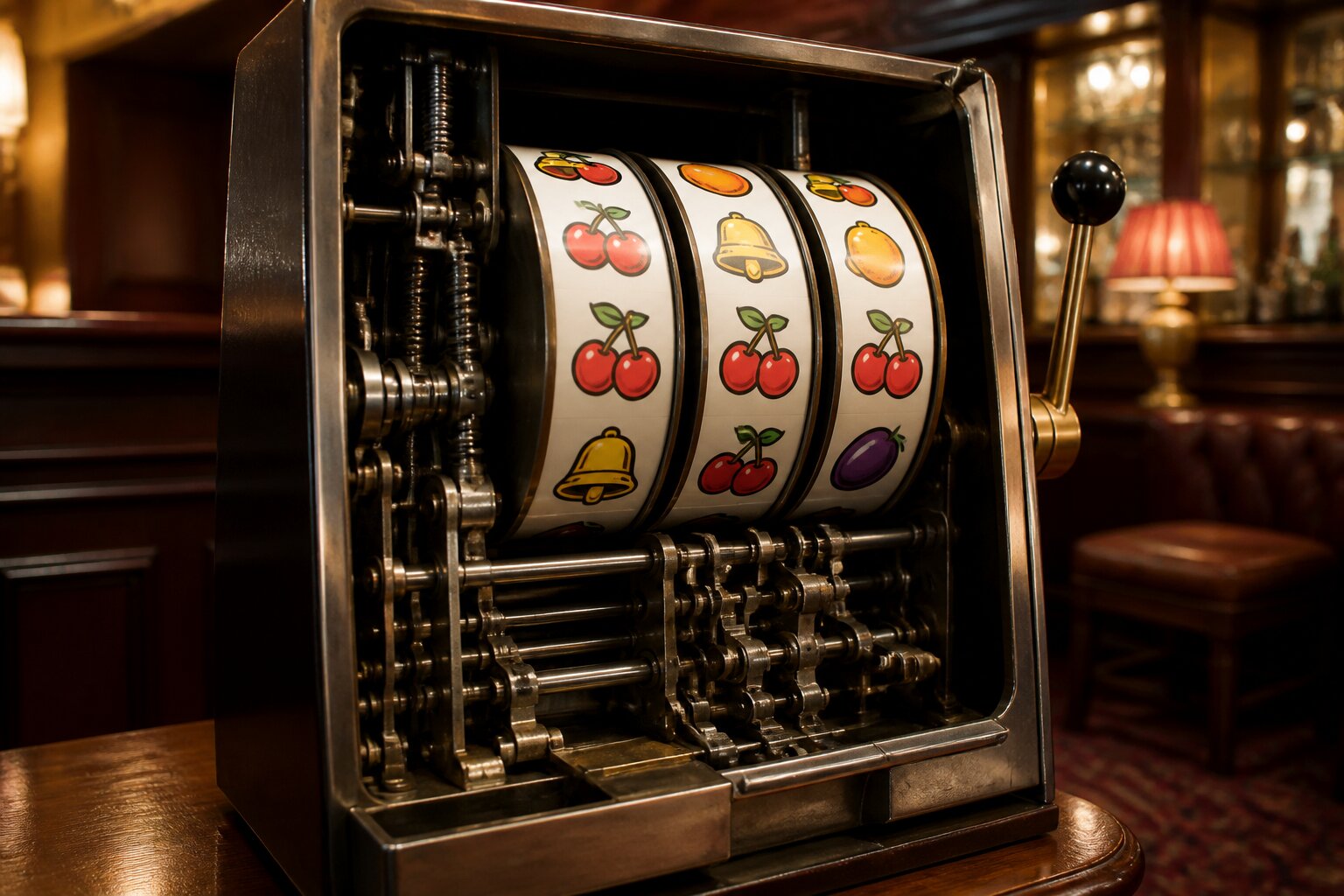
Ever felt drawn to the spinning reels of a classic slot machine? Their lights and the mechanical clunk when coins drop have a way of holding your attention. These machines are built around simple, robust engineering rather than software or screens.
Before digital games took over, mechanical slots were the staple of pubs and casinos. If you enjoy history, hands-on mechanics, or simply want to know how those reels decide an outcome, this guide will walk you through the inner workings and explain why these machines still fascinate people today.
Let’s open one up and see what makes a classic slot tick.
What Are Mechanical Slot Machines?
Mechanical slot machines are traditional gambling devices that rely on physical reels, springs, gears and levers to produce outcomes. You interact with them by inserting a coin and pulling a lever, which sets the internal mechanism in motion and spins the reels.
They first appeared in the late 1800s and quickly became a fixture in leisure venues. Unlike modern digital versions, these machines do not use software or random number generators. Instead, outcomes emerge from the arrangement and interaction of mechanical parts. That tangible, analogue operation is what gives them their distinct character.
These machines are still subject to regulatory fairness checks and must operate according to the rules that apply in their jurisdiction.
Inside the Classic Slot Machine: Key Components Explained
At the core are the metal reels, typically three, each marked with a sequence of symbols. When the lever is pulled, a catch releases and stored energy in a spring is used to spin the reels. Gears and cams control the speed and deceleration of those reels so that they do not all stop at once.
Stops and notches around each reel determine the final resting positions. As a reel slows, a stopper engages a notch and holds it in place. The particular combination of symbols that lines up on the payline is then checked by the machine’s payout mechanism.
Payouts are handled by mechanical linkages. If the alignment matches a winning combination, small arms or levers open a reservoir and coins fall into the tray. All these parts interact in a pre-set way, so the machine’s behaviour reflects its physical design.
How Does the Spinning Mechanism Operate?
Pulling the lever starts a sequence of mechanical actions. The lever tensions a spring and releases a catch. That release lets the reels spin under stored energy rather than continuous manual force.
During the spin, cams and gears moderate the motion so reels decelerate at slightly different times. Stoppers then engage individual notches and fix each reel into place. The combination of notches occupied defines the visible symbols and therefore whether the outcome is a payout.
This process is governed entirely by the machine’s mechanics. Once the lever is pulled, nothing a player does during the spin will alter where the reels stop.
What Role Do Springs, Levers & Reels Play?
Springs supply the stored energy that drives the reels. Their tension determines how forceful a spin is and affects timing through the mechanism. The lever is the operator interface that transfers human input into mechanical action. Reels carry the symbols and, through their spacing and number of stops, set the mathematical structure of possible outcomes.
Together these elements produce a predictable mechanical response to the same input, but the specific point where each reel stops depends on the arrangement of stops and the action of stoppers, which creates variety in results.
The Coin Slot and Payout System
The coin slot performs a simple verification to accept genuine stakes, after which it unlocks the mechanism that allows the lever to operate. Inside, the payout system consists of mechanical linkages that measure winning alignments and release coins from a stored tray.
Payout amounts are fixed by the machine’s design. When the payout mechanism is engaged, coins are released and guided into the tray for collection. Maintenance and inspection routines ensure these systems work as intended and pay according to the machine’s specification.
How Do Mechanical Slot Machines Generate Payouts?
Payouts arise from the physical alignment of symbols on the reels. Each reel’s stops correspond to specific symbols and, when a designated sequence appears on the payline, mechanical detectors trigger the release of coins.
The detector mechanism is a network of arms and levers that respond to precise positions of the reels. The volume of coins dispensed matches the payout table built into the machine. Because the payout behaviour is set by hardware, operators cannot change outcomes on the fly; regular checks confirm the machine pays out as designed.
Regulatory standards require documented odds and inspections so consumers can be confident machines meet the mandated operating criteria.
Are Payouts Truly Random in Mechanical Slots?
Payouts are unpredictable to the player because the precise stopping point of each reel depends on multiple interacting mechanical factors. These include the position of the reels, the weight and balance of the stops, and the physical condition of the machine. Together, they produce outcomes that cannot be foreseen by someone playing.
However, the probabilities of different outcomes are determined by the number of stops and the distribution of symbols on each reel. The machine’s internal layout fixes how often each symbol can appear and therefore sets the long-term frequency of winning combinations. This is a matter of design rather than moment-to-moment chance control.
Each spin is an independent event. Past spins do not influence future spins, and there is no memory in the machine that alters odds based on recent results. Short-term streaks or runs of wins and losses are a normal consequence of randomness and the underlying distribution of symbols, not evidence of changing odds.
Knowing this helps explain why patterns that seem apparent to players do not indicate an underlying, changeable trend. Perceived patterns are usually a result of variance and human tendency to find meaning in random sequences. Players cannot reliably predict or affect outcomes, and the machine’s construction alone determines the statistical behaviour over time.
Common Myths About Mechanical Slot Machines Debunked
There are several persistent beliefs that do not stand up to the machine’s mechanics. For example, the idea that pulling the lever in a particular way or timing a spin can affect the result is incorrect. The internal components determine outcomes, and player actions after the lever is pulled do not change them.
Another myth is that machines alternate between phases of frequent payouts and long dry spells due to some internal cycle. Because the distribution of symbols and stops is fixed, apparent streaks are simply the result of independent spins and not a deliberate pattern created by the machine.
Understanding how the mechanics work removes the mystery and shows that outcomes follow the machine’s hardware design.
Mechanical vs Modern Digital Slot Machines: What Are the Differences?
The main distinction is physical versus algorithmic determination of results. Mechanical machines use tangible reels, stops and levers. Digital machines use software driven by random number generation to select outcomes. Both systems can be tested and regulated, but the ways they accomplish randomness differ.
Mechanical machines display outcomes directly through moving parts and coin payouts. Digital slots present results through screens and often include additional features such as bonus rounds or variable pay tables that are implemented in code rather than hardware. Despite these differences, both types are subject to oversight to ensure they conform to fairness standards.
If you enjoy the tactile nature of reels and audible coin drops, the mechanical experience feels very different from the fast, feature-rich environment of modern digital games.
Why Do Classic Mechanical Slots Remain Popular?
The lasting appeal of mechanical slots comes from their tangible operation and straightforward gameplay. The physical act of pulling a lever and watching metal reels turn provides a direct connection between player and machine that many find satisfying in its own right.
Beyond the mechanics, the simplicity of these machines makes them easy to understand. There are typically fewer rules and no layered bonus features, so a new player can grasp how a win is determined in a few moments. That clarity, combined with routine maintenance and regulatory checks, keeps them a trusted option for enthusiasts and collectors.
Whether you are drawn by nostalgia or the engineering, classic mechanical slots offer a distinct experience within the history of gaming.
**The information provided in this blog is intended for educational purposes and should not be construed as betting advice or a guarantee of success. Always gamble responsibly.