
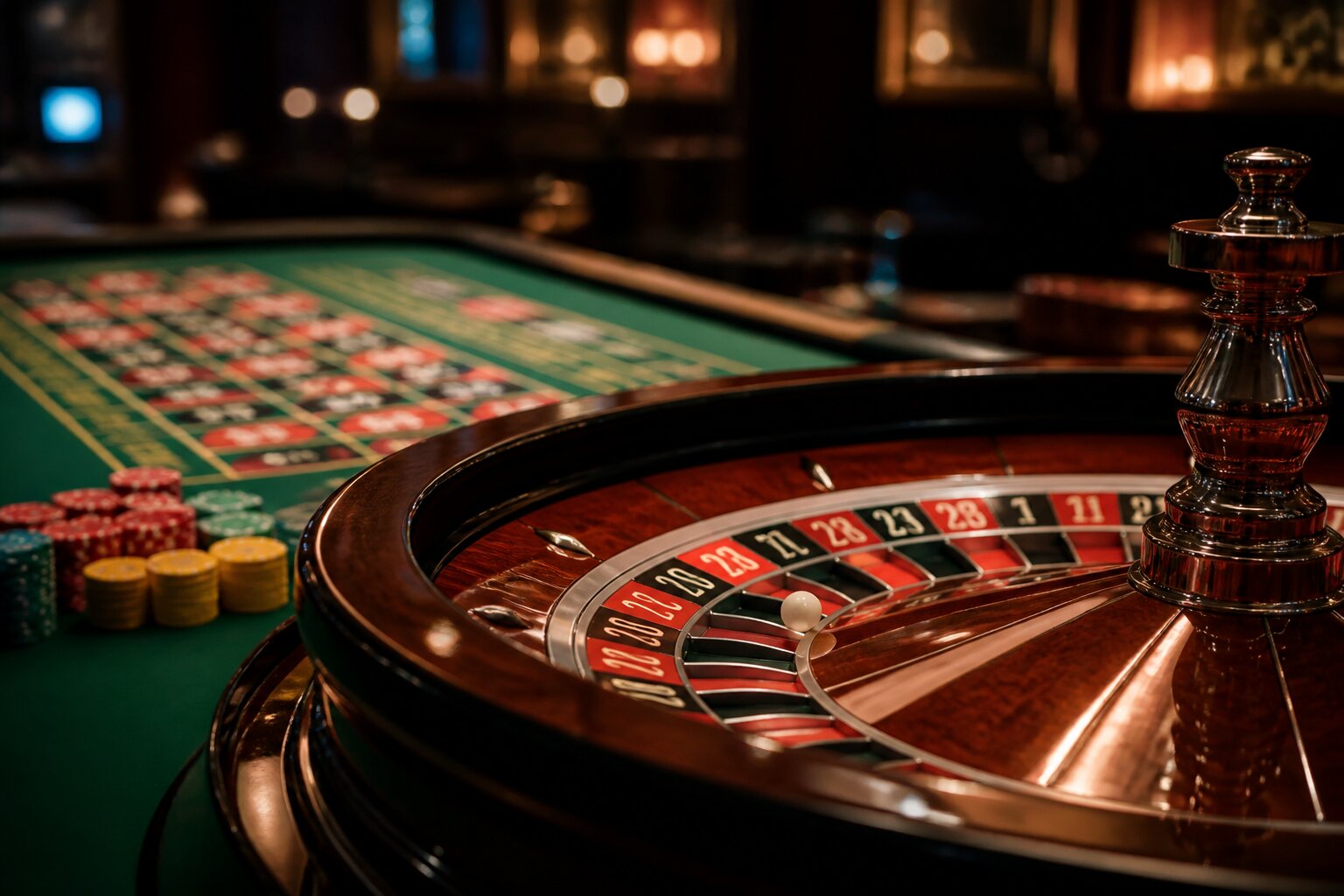
Ready to make your 20p go further at the roulette table? Whether you’re new to the game or simply prefer low-stakes play, 20p roulette lets you explore different bets and strategies without a big outlay.
This article walks through what 20p roulette is, how strategies for small stakes differ from higher-stake tables, the maths behind odds and payouts, the most common approaches players use, mistakes to avoid, and a clear view on what strategies can and cannot change. Keep reading to find the approaches that suit your style and budget.
If you want a quick overview before diving deeper, the next sections explain the game itself and why a lower minimum alters how people play.
What Is 20p Roulette?
20p Roulette is the same core game as European roulette but with a lower minimum stake, allowing individual wagers from 20 pence. The wheel has a single zero and the layout features the familiar inside-number grid and outside betting areas. Everything you can bet on at standard tables — straight-up numbers, splits, streets, corners, red/black, odd/even and the dozens and columns — is available here, just at smaller stakes.
Low minimums mean the table suits casual sessions, experimenting with different bets, and testing small-scale strategies without placing large sums down. It still requires players to be aged 18 or over and to follow the platform’s terms, but the main appeal is that a modest bankroll can buy many spins and a variety of betting patterns — useful background for considering how strategy changes at this level.
Because the format and payouts match the usual European rules, the next section explains how having a 20p minimum alters the practical choices a player makes.
How Do 20p Roulette Strategies Differ from Standard Roulette?
With only 20p per wager, bankroll management becomes central to the way people approach the table. The low stake lets you spread a fixed amount of money across many more spins than at higher minimums, which affects both risk tolerance and the kinds of strategies that are practical.
For instance, a £10 budget yields 50 single bets at 20p compared with ten single bets at £1. That increased sample of spins encourages players to try a range of bets, experiment with short progressions or combine inside and outside bets, without risking large sums quickly. Conversely, at higher minimums players tend to favour steadier, conservative approaches because each loss eats a bigger chunk of their funds.
Lower stakes also make it easier to pause, reassess and adapt mid-session: splitting a budget into blocks of spins, reserving winnings as a separate pool, or switching between outside bets for steadier returns and occasional inside bets for bigger payouts. The next section unpacks the underlying odds and payouts so those strategic choices sit on a clear numerical foundation.
Understanding Odds and Payouts in 20p Roulette
Payouts and probabilities in 20p Roulette follow the same structure as standard European roulette; only the stake size changes. Every bet type has a fixed payout ratio reflecting how many numbers it covers.
A straight-up bet on a single number pays 35 to 1. On a 20p stake that means a total return of £7.20 (the £7 winnings plus your 20p stake). Split bets cover two numbers and pay 17 to 1, so a 20p split returns £3.60. A street bet across three numbers pays 11 to 1; a corner (four numbers) pays 8 to 1; a line bet covering six numbers pays 5 to 1. Outside bets such as red/black, odd/even or high/low pay even money (1 to 1), while dozens and columns pay 2 to 1.
Because there is a single zero on the wheel, the house edge for European roulette is 2.7%. That percentage is independent of the stake amount, so whether you bet 20p or a larger sum the mathematical advantage to the house remains the same. With that in mind, the following section describes common strategies players use at 20p tables and what they aim to achieve.
Most Popular 20p Roulette Strategies Explained
Players tend to use strategies that match the risk profile and tempo allowed by 20p stakes. Below are the key approaches, why they are used, and how they typically play out in practice.
Inside Bets Strategies
Inside bets focus on specific numbers or small groups of numbers. They pay higher returns but hit less often, so they are often used sparingly within a session.
Straight-up bets (one number) offer the biggest single-number payout and are sometimes used as an occasional “swing” bet when a player wants a larger payout without raising the ongoing stake. Split, street, corner and line bets allow a player to cover more numbers for a lower per-number cost, providing ways to chase higher payouts while keeping each spin at the 20p level. Many players will mix one or two inside bets into a session dominated by outside wagers to balance the chance of occasional larger wins against more frequent small returns.
Outside Bets Approaches
Outside bets cover broader groups and produce more regular outcomes at lower payout ratios. They are well suited to sessions where preserving the bankroll and prolonging play are the priorities.
Bets such as red/black, odd/even and high/low return even money and are commonly used to produce steady wins that keep a session moving. Dozens and columns offer 2 to 1 payouts and are a middle ground: they increase the payout potential while still covering a third of the numbers on the wheel. Players often use outside bets to stabilise swings from inside bets, or to form the backbone of a session and then add occasional inside wagers for variety.
Managing Your Stake for Longer Play
Effective stake management shapes how long a 20p session lasts and how much exposure a player accepts. Some adopt flat betting — keeping each wager at 20p — which simplifies decisions and preserves bankroll predictability. Others use modest progression systems, increasing stakes in a controlled way only within preset limits and stopping if losses exceed a planned threshold.
Practical approaches include dividing the bankroll into blocks for a set number of spins, earmarking winnings separately to avoid spending the original stake, and taking scheduled breaks to reassess. These methods help players maintain control and ensure the session remains affordable and enjoyable. With this structure in mind it’s also important to be aware of common pitfalls that can erode both funds and fun.
Common Mistakes to Avoid When Playing 20p Roulette
Even small stakes can add up if play is unfocused. One frequent mistake is increasing stakes impulsively after a run of defeats; rapid escalation can quickly outstrip a modest bankroll. Another is playing on autopilot without checking bets before a spin — misplacing chips or accidentally covering different numbers is a surprisingly common source of unintended losses.
Failing to set or monitor a budget and not taking breaks also contribute to overspend over multiple short sessions. Finally, adopting complex systems without understanding their mathematical implications can create confusion and poor decision-making. Keeping bets simple, checking stakes each spin, and using clear bankroll divisions reduces these risks and preserves the core enjoyment of the game.
Having covered what to avoid, the next section takes a realistic view on whether any strategy can change the expected outcome in roulette.
Can You Really Improve Your Roulette Results?
Roulette operates with random outcomes on each spin and a stable house edge. No betting system can alter those underlying probabilities or guarantee long-term profit; changing the stake size or sequence of bets does not change the expected return per spin. Strategies can, however, influence session shape — how long you play, how volatile your bankroll is, and whether you experience a few larger wins or many small ones.
For example, focusing on outside bets tends to produce steadier, smaller wins that stretch a bankroll, while occasional inside bets can provide bigger payouts though with lower hit frequency. Progression systems can create short-term swings but also raise the risk of large losses if the sequence goes against you. The practical value of any strategy is therefore about managing exposure and preserving enjoyment rather than improving the long-term odds.
Accepting the mathematical limits while using sensible stake control, variety in bet types, and occasional pauses helps players keep sessions pleasurable and within their means. With that perspective, apply the approaches outlined here to shape sessions that match personal limits and preferences.
Explore Casino Games at Slots Baby
We welcome you to experience a relaxed atmosphere and explore all that our site has to offer at your leisure. There’s no rush—just a friendly space for you to discover casino games in your own time.
Getting started is straightforward: simply create an account, make a deposit and you’ll be ready to play. We look forward to seeing you at Slots Baby.
**The information provided in this blog is intended for educational purposes and should not be construed as betting advice or a guarantee of success. Always gamble responsibly.